Is Gozalandia Waterfall Safe?

I've swum at Gozalandia more times than I can count, and I've also stood at the top of those stairs on a morning after heavy rain and told my own cousins to turn around. So is Gozalandia Waterfall safe? As of September 2026, it is an unstaffed natural swimming hole on private property in San Sebastián. There are no lifeguards, no posted safety staff, and no official body inspecting the ropes or the ledges. That doesn't mean it's dangerous by default; it means the safety of your day here depends almost entirely on the water condition and your own judgment, not on anyone watching over you. This page is the honest version of that answer, risk by risk.

Quick answer
Gozalandia is genuinely enjoyable and generally safe on a clear day for a confident swimmer using good judgment, but it is not a supervised attraction. There is no lifeguard on duty, the falls sit on private property with no official safety inspection, and the two real hazards are slick rocks around both cascades and a river that rises fast after heavy rain. Skip the rope swing, the jumps, and the cave entirely if the water looks brown or is rising; on a normal day, most visitors swim, jump low, and leave with nothing worse than a scraped knee.
Key takeaways
- No lifeguard is on duty at any point on the property; you are responsible for your own water judgment
- The two hazards that matter: slick rocks year-round and fast-rising water after heavy rain, covered below
- The rope swing and the underwater cave are strong-swimmers-only calls, never attempted in brown or rising water
- A guided river hike, $85, puts someone who knows the current ledges and the rain rule next to you
- Children under 6 are generally not recommended on guided tours here; see our with kids page for the full family breakdown
- What to actually wear and bring for the slick sections is covered separately on our gear guide
Who Should Reconsider
If You are not a confident swimmer
Stick to the calmer, shallower lower falls and skip the upper pool, the swing, and the cave entirely.
If You have a heart condition or high blood pressure
Talk to your doctor about cold spring-fed water and the exertion of the trail and the jumps before you go.
If You are traveling with a child under 6
See our with kids page; guided tours here generally do not recommend that age group.
If It has rained heavily in the last day or the water looks brown or is visibly rising
Stay out of the water entirely, skip the swing, the jumps and the cave, and come back another day.
If You want an experienced local eye on the current conditions
Book the river hiking tour rather than going in cold on your own.
The Short Answer: Safe on a Dry Day, With Judgment
On a clear day in the 2026 season, with normal water levels, Gozalandia is one of the friendlier waterfalls in Puerto Rico to swim at. The trail is short and paved with handrails along the main steps, the plunge pools are deep enough to swim comfortably, and the layout (upper falls for the adventurous stuff and lower falls for a calmer wade) lets most groups split up by comfort level without anyone missing out. What changes the picture entirely is tropical rain, affecting both water clarity and current speed, and that single variable is worth understanding before you ever look at the rope swing.
The Real Risks and How to Manage Them
Three mechanisms account for almost everything that goes wrong here, and each has a real, specific way to manage it.
| Situation | What to do | Warning sign |
|---|---|---|
| Slick rocks near either cascade | Use the fixed ropes on steep or wet sections, wear shoes with real grip, move slowly on wet stone rather than rushing | Rocks that look dry can still be slick from spray; test footing before committing weight |
| Jumping without checking depth first | Always check the pool depth yourself before jumping, even on a ledge you've used before | Pool bottoms shift after storms, so a ledge that was safe last month may not be this month |
| Current and clarity after heavy rain | Stay out of the water entirely if it's brown or visibly rising; wait it out or come back another day | Brown, cloudy or fast-moving water, or a noticeable rise at the pool edges |
None of these three is exotic or hard to manage. They're also the exact three things a rushed visitor skips: nobody reads a warning sign while excited to jump in, which is precisely why they're listed here in plain language rather than buried in a waiver.
The Rope Swing: How It Works and When to Skip It
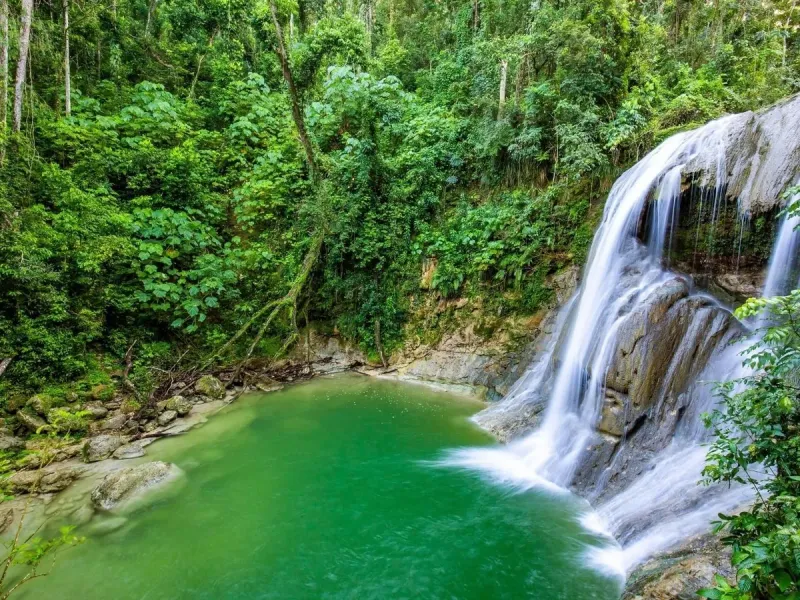
The rope swing hangs over the upper falls' pool, a deep plunge pool that comfortably absorbs the swing's arc on a normal day. The mechanics are simple, grab the rope, swing out over the pool, let go at the top of the arc, and drop into open water well clear of the rocks. It's genuinely one of the more fun things to do at Gozalandia, and most visitors who try it have no trouble at all.
The rule that matters: skip it entirely if the water is brown or rising. A pool that's cloudy from recent rain hides its own depth and any debris that's washed in, and a rising current changes exactly where you land relative to the rocks. On a clear day, with normal pool depth, the swing is a low-drama, high-fun addition to the visit. After heavy rain, it's simply not worth it, and nobody who actually knows this place uses it under those conditions.
Jumping: Heights, Depth Checks, and the Ledges Locals Use
Locals jump from ledges up to about 30 feet at the upper falls, a height that looks casual to people who grew up doing it and looks like a lot to everyone else, correctly. If you're visiting for the first time, start low. There are lower ledges that give you the same rush with a much smaller margin for error, and there's no reason to work your way up to the higher spots on your first visit.
The habit that actually matters more than the height itself: check the depth yourself before every single jump, even from a ledge you used ten minutes ago. Pool bottoms shift after storms, sediment moves, and rocks that weren't a concern last season can surface closer to the landing zone than you'd expect. This isn't a one-time check on arrival; it's a before-every-jump habit, and it's the single biggest difference between an experienced local's jumping routine and a visitor's.
The Cave Behind the Upper Falls
Beside the upper falls sits an underwater cave passage, one of the things people travel here specifically for. To get in, you duck under a rock ledge through about a foot of water and surface inside an air chamber roomy enough to fit six or more people comfortably. It's a striking, slightly disorienting couple of seconds, dark water then suddenly a rock ceiling and open air above you, and most people who try it love it.
This is a strong-swimmers-only feature, full stop. The duck-under passage is brief but it is genuinely underwater, and anyone uncomfortable holding their breath for a few seconds while navigating a rock ledge should skip it. Never attempt the cave in brown or high water; the same current that makes the rest of the property risky after rain makes a confined underwater passage a genuinely bad idea, since visibility and current both work against you at exactly the moment you need to judge the ledge correctly.
Rain and Flash-Flood Awareness
This is the single most important safety fact on this page: the river at Gozalandia rises fast after heavy rain, faster than the clear sky over the parking lot might suggest, because storms upstream in the hills can raise the water here before any rain falls on you directly. Brown or visibly rising water is the signal to get out immediately and skip the swing, the jumps and the cave until conditions clear.
August to November are the wettest months in western Puerto Rico, which means afternoon storms and higher baseline water levels are more likely during that stretch; December to April runs drier and generally calmer. Neither window guarantees anything on a given day, since a single storm can change conditions regardless of season, but if you're planning a trip specifically around dry conditions, the drier months give you better odds.
Who Shouldn't Swim Here: Restrictions at a Glance
Pulled honestly from what our guided operators actually flag, not invented.
| Restriction | Typical guidance | Why | Ask before booking if… |
|---|---|---|---|
| Children under 6 | Generally not recommended on guided tours | The trail's stairs, current, and swim depth are a lot for a very young child | Traveling with a toddler; see our with kids guide for the fuller answer |
| Non-swimmers | Stick to the lower falls' shallow wading area | The upper pool, the swing and the cave all require confident swimming | You or anyone in your group isn't a strong swimmer |
| Heart condition or high blood pressure | Ask your doctor about cold water exposure and trail exertion first | Spring-fed water runs in the low 70s Fahrenheit even on a hot day | You have a diagnosed cardiovascular condition |
| Mobility limitations | The trail includes stairs on both sides; the lower-falls branch is steeper | No paved, step-free route exists to either falls | Stairs or uneven terrain are a genuine concern for you |
| Pregnancy | Use personal judgment; the trail and jumps are not built for it | Steep stairs, slick rocks, and any jumping are a poor combination during pregnancy | You are pregnant and considering the upper trail or any jump |
Why a Guide Changes the Math
Nothing about a guide makes the water itself safer; the current is the current whether or not someone is standing next to you. What a guide changes is judgment under uncertainty, exactly the part of this page that's hardest to get right from a blog post alone. A guide who visits weekly knows what the water looked like yesterday, knows which ledges have shifted recently, and will tell a group plainly when conditions call for skipping the swing that day.
The Gozalandia river hiking and waterfall tour, $85 for 3 hours, puts exactly that kind of local knowledge next to you for the whole visit. For a fuller day with the same guided judgment call built in, the private Gozalandia waterfall tour from San Juan runs 7 to 8 hours at your own pace with a certified guide. Neither tour eliminates risk; both put someone experienced between you and the decision of whether today is a swing-and-cave day or a lower-falls-only day.
What If Something Goes Wrong
911 works normally here, since Puerto Rico is a US territory, and it's the right first call for anything serious. The nearest full hospitals sit in the Mayagüez and Aguadilla areas, a real drive from San Sebastián rather than a quick trip, which is exactly why judgment before you jump matters more here than at a spot with an emergency room five minutes away. There is no on-site medical staff or lifeguard to flag down; the family running the property can help in a pinch, but they are not first responders.
The one safety lever entirely within your control is the same one repeated across this page: check the water condition honestly before you commit to the swing, a jump, or the cave, and be willing to sit that part out on a bad day. Nearly everything that goes wrong at a natural swimming hole traces back to someone deciding the water looked fine when it didn't.
Frequently Asked Questions
Is there a lifeguard at Gozalandia Waterfall?
No. Gozalandia is an unstaffed natural swimming hole on private property, and there is no lifeguard on duty at either the upper or lower falls.
How do I know if the water is too dangerous to swim in?
Brown, cloudy or visibly rising water is the clear signal to stay out entirely and skip the swing, jumps and cave. On a normal clear day with typical flow, swimming is generally fine for confident swimmers.
Is the rope swing at Gozalandia hard to use?
No, the mechanics are simple: grab the rope, swing out over the deep plunge pool, and let go at the top of the arc. The judgment call is condition-based, not skill-based, since it should only be used in clear, normal-level water.
How high are the jumps locals do at Gozalandia?
Up to about 30 feet from certain ledges. First-time visitors should start from lower ledges and check the pool depth themselves before every jump, since bottoms shift after storms.
What months have the roughest water conditions at Gozalandia?
August through November tend to run wetter in western Puerto Rico, with more afternoon storms and higher baseline flow. December through April is generally drier and calmer, though a single storm can change conditions in any month.
Is the water at Gozalandia cold?
It stays cool, generally in the low 70s Fahrenheit, since it's spring-fed, even when the air temperature runs 75 to 90 Fahrenheit. Worth knowing for anyone with a cardiovascular condition, who should check with a doctor first.
What's the closest hospital to Gozalandia if something goes wrong?
The nearest full hospitals are in the Mayagüez and Aguadilla areas, a real drive from San Sebastián. 911 works normally across Puerto Rico for anything urgent.
Gozalandia rewards good judgment more than it punishes bad luck. On a clear day, most visitors swim, jump low, and leave happy; the honest exceptions are brown or rising water, non-swimmers heading past the shallow wading area, and anyone with a real medical reason to sit the trail out. For anyone who'd rather have a local eye on conditions than guess alone, the waterfall day trips in western Puerto Rico we compare here all come with a guide who makes that call daily.